 Philippines

Life is Better with π: a new dimension of selectivity in HPLC for the analysis of quaternary ammonium compounds
27 de October de 2026The analysis of quaternary ammonium compounds does not always provide optimal resolution when a conventional C18 column is used. When working with aromatic, unsaturated or complex molecules, alternative retention mechanisms make the difference between an acceptable separation and excellent resolution. Stationary phases based on π-π interactions offer an innovative solution. Inspired by a recent MACHEREY-NAGEL application, we show how the NUCLEODUR® π2 column opens up new possibilities for food safety laboratories.
What are quaternary ammonium compounds (QACs)?
Quaternary ammonium compounds (QACs) are biocides widely used in the food and beverage industry. They stand out for their disinfectant properties and non-corrosive nature. They are also used in agriculture as plant strengtheners and for the disinfection of processing equipment.
Their extensive use can result in residues on fruit and vegetables, both from conventional and organic farming. That is why the analysis of quaternary ammonium compounds is essential to guarantee food safety and regulatory compliance.
Beyond C18: the power of π-π interactions
The NUCLEODUR® π2 column incorporates a hydrophobic phase with alternative selectivity to conventional C18 phases. It combines two retention mechanisms:
- Traditional hydrophobic interactions.
- π–π interactions between the stationary phase and the analytes.
This dual action significantly improves the retention and selectivity of aromatic and unsaturated compounds. This enables separations that are difficult to achieve with conventional phases and improves the analysis of quaternary ammonium compounds.
Advantages of NUCLEODUR® π2 technology
- Greater retention for aromatic and unsaturated substances.
- Orthogonal selectivity compared to conventional C18 columns.
- Excellent performance under highly aqueous conditions.
- Particularly marked selectivity differences when using acetonitrile and methanol as organic modifiers.
- Improved resolution in complex mixtures.
These characteristics make NUCLEODUR® π2 a particularly interesting tool for applications in food safety, environmental analysis, pharmaceutical analysis and quality control laboratories.
Application: determination of QACs by HPLC
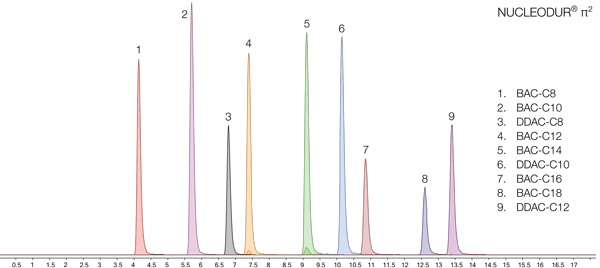
The application developed by MACHEREY-NAGEL demonstrates the efficient separation of different quaternary ammonium compounds by HPLC using the NUCLEODUR® π2 phase. Thanks to the additional π-π interactions, the column provides enhanced selectivity for this type of compound, enabling more reliable identification and quantification of residues present in food matrices.
When selectivity makes the difference
The evolution of stationary phases is enabling increasingly complex analytical challenges to be addressed. Columns with π-π chemistry, such as NUCLEODUR® π2, offer a valuable alternative when traditional phases do not provide the necessary resolution. For laboratories looking to optimise their HPLC methods or develop new applications, incorporating complementary retention mechanisms can be the key to achieving more robust, selective and efficient separations.